Co-Managed IT vs. Fully Outsourced IT: What Is Better for Small Businesses in Atlanta?

By Rich Edmundson
President of WideData
Rich Edmundson leads WideData's managed IT and technology consulting practice from the company's Peachtree Corners headquarters. With a background in Computer Science from the University of Florida and University of Central Florida, Rich has spent his career helping Atlanta-area SMBs build IT environments that support growth without the overhead of enterprise-scale departments.
If you are a small or medium-sized business owner (SMB) in Atlanta, there is a high chance that you are already at a stage where asking your tech-savvy nephew for help is no longer enough. However, it may seem like a huge step to hire an entire IT department. You are then left with two big choices: co-managed IT and fully outsourced IT, both of which appear to be expensive at first. Which one actually suits your business in Atlanta?
Here is a short reply: Co-managed IT is ideal for Atlanta SMBs that have an in-house IT person or team but need additional support, such as cybersecurity, project work, or after-hours coverage. Fully outsourced IT is the best option when you do not have any IT personnel or want to completely take IT stress off your hands. Your company's size, budget, growth stage, and industry compliance requirements will determine the matter.
Let's explore the topic so you can make your decision.
TL;DR: Quick Summary
Co-managed IT is a partnership between an in-house team and a local managedservice provider (MSP).
Fully outsourced IT is when a local MSP acts as your entire IT department.
Co-managed IT is usually charged à la carte while fully managed IT is charged peruser.
Atlanta SMBs with 25-250 employees and at least one dedicated IT person aregreat co-managed IT candidates.

What really sets apart co-managed IT from fully outsourced IT in Atlanta?
Co-managed IT is a collaboration model. The internal IT team at your Atlanta business works hand in hand with a local managed service provider (MSP) on the chosen activities—could be cybersecurity, 24/7 monitoring, or large projects. Your in-house IT person remains in control of the day-to-day operations, but they receive the support and expertise of the new specialized contact when necessary.
Fully outsourced IT means the MSP handles everything like your complete IT department. They take care of everything from help desk support and system monitoring to backups, security, and even strategic IT planning. There will be no need for you to have any internal IT employees on your payroll.
The main contrast centers on who performs everyday activities. With co-managed IT, the load of work is shared according to roles. With full outsourcing, the MSP is the one running the show, and you just get out of the IT business altogether.
Imagine it this way: co-managed is like hiring a professional to work side by side with your team. Fully outsourced is like hiring an agency to be your team.

How much does co-managed IT or fully outsourced IT cost for Atlanta SMBs?
The vast majority of the Atlanta-based managed IT service providers (MSPs) set the price for fully managed IT somewhere between $100 and $250 per user per month, depending on what is included and what your security requirements are. It commonly covers help desk support, system monitoring, patching, backups, and core cybersecurity. If your organization is in need of further compliance support, such as HIPAA or PCI, the price can increase.
Co-managed IT in Atlanta is mostly charged on a service basis. You only pay for the services that your business needs—like advanced security monitoring, project work, or after-hours support. This flexible method would be logical if you are already paying for internal IT and just need to fill certain gaps.
For reference, the hiring of an in-house IT manager in the U.S., including salary and benefits, costs $90,000–$130,000 per year. A fully managed IT contract typically costs less than two full-time IT employees while delivering more comprehensive coverage and 24/7support.
The real thing to discuss is not which one is cheaper, but which one gives you the coverage you really need, and at the same time, you are not overpaying for those you are not using.
What size company is right for each model?
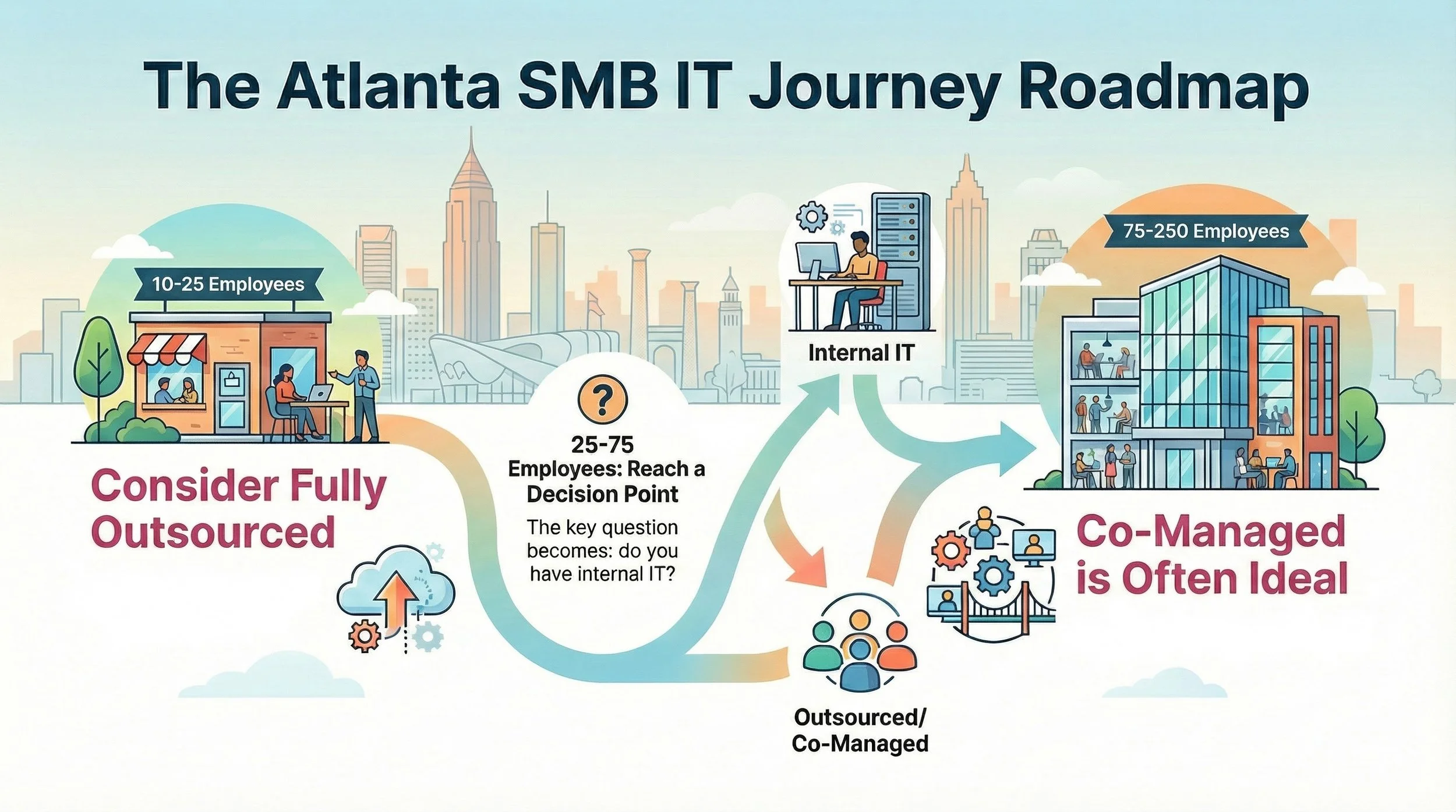
Co-managed IT is often the best option for SMBs in Atlanta with 25 to 250 employees, with at least one person dedicated to an IT role. Your business has grown to the point where you need internal IT services, yet your staff is overworked and would benefit from a reliable support system.
Full outsourcing of your IT department is an ideal solution if your business in Atlanta is small, typically with a headcount between 10 and 75, and the cost of employing a full-time IT person does not appear to be justified financially. Additionally, it is suitable for companies that are larger in size and wish to focus on their main business activities while entrusting the IT function to a single provider.
Atlanta MSPs can cater to both models and support a wide range of company sizes as well. They can fully manage environments of a few hundred seats where the client has decided that IT is not their core business. On the other hand, they can also team up with internal IT departments at companies that want to grow without excessive hiring.
There is no perfect figure. The main thing is whether you have the internal IT capability and whether you want to maintain it or not.

How do I know if I need co-managed IT?
Life would become a lot easier for your internal IT if they were not constantly overloaded, if they had advanced skills in security and cloud technologies, or if they were able to regularly work on projects and plan strategically.
Here are the signs:
Your IT team is always under pressure, and there is no proper security.
There is no clear IT strategy, and the employees do not have clear instructions or the tools they need.
Your internal staff is untrained in advanced technologies, and you are too tightly staffed tohandle digital transformation.
You are constantly forced to hire more people to meet the growing workload, only to findthat you are still understaffed in key areas.
Your employees waste time on duplicate tasks because there is no automation or standardized processes.
Should any of these points sound like your situation, co-managed IT is likely the perfect match for your company.
What are the pros and cons of each model?
Model
Pros
Cons
Co-Managed IT
- Keep control and institutional knowledge
- Add new skills (security, cloud, compliance)
- Be flexible—scale support up or down
- Provide mentorship and backup to your internal IT team
- You have to define roles clearly, otherwise gaps might occur
- You are still responsible for the internal IT fully loaded wage rate
- If responsibilities aren't properly documented, there might be finger-pointing
Fully Outsourced IT
- One single provider is accountable for everything
- Predictable monthly cost
- 24/7 help desk and monitoring available
- No headaches from IT hiring, training, and management
- Less control over setting the priorities
- Becoming dependent on one vendor
- The risk of poor fit if the MSP is not familiar with your business
| Model | Pros | Cons |
|---|---|---|
| Co-Managed IT |
|
|
| Fully Outsourced IT |
|
|
Neither of the models is universally better. It comes down to your starting point and what compromises you are ready to make, control or simplicity.
Which industries in Atlanta benefit most from each model?
Metro Atlanta SMBs, including the architecture, engineering, and construction (AEC) industry, healthcare, and finance sectors, are generally strong candidates for fully outsourced IT with a robust compliance layer. The reason is that these industries are governed by HIPAA, PCI DSS, SOC 2, and other standards that require a very high level of security, which is not feasible to build in-house for most players.
Manufacturing, architecture & engineering, and real estate are the sectors that were moving forward the most with co-managed IT. These types of businesses generally have some internal IT capabilities but need help with uptime, cloud infrastructure, and cybersecurity without adding a lot of staff.
As one of the largest and most competitive MSP markets in the Southeast, with strong demand fueled by security concerns and digital transformation, Atlanta is seeing many local businesses opting for managed models—either co-managed or fully outsourced—to get enterprise-level coverage at SMB-friendly prices.
Decision Matrix: Which model fits your business?
Use this as a quick gut-check:
| Factor | Choose Co-Managed If... | Choose Fully Outsourced If... |
|---|---|---|
| Internal IT Staff | You have 1+ IT people | You have no IT staff |
| Budget Priority | Maximize your existing IT investment | Get predictable, all-in monthly cost |
| Control | You want to keep IT leadership in-house | You want one provider fully accountable |
| Growth Stage | Scaling and need to augment without over-hiring | Early stage or lean—don't want to build IT |
| Compliance | Need help with specific frameworks | Need end-to-end compliance management |
| Coverage Gaps | Need 24/7, security, or project overflow | Need full help desk + monitoring |
What are the warning signs that indicate your current IT setup is not functioning properly?
Common warning signs are frequently occurring outages, slow ticket response times, outdated systems, untested backups, and unclear compliance. If IT is something that holds back your development rather than being a tool for growth, then you probably need a change.
Ask yourself:
How much time does your IT team spend on redundancy and firefighting?
How secure are your systems and data?
What is your experience with unresolved tickets or downtime?
Do you have a regularly updated and implemented IT strategy?
How often do you suffer from lack of backups and failed data recovery?
Are your IT tools, processes, and security compliant with relevant regulations and standards?
It will be a good sign of the need for a change if you find three or more of these criteria to be true in your experience.

Frequently Asked Questions
What is the average cost of managed IT services in Atlanta?
Managed Service Providers in the Atlanta area tend to bill their clients from $100 up to $250 per user monthly for fully-managed IT services. This is, however, subject to the extent of work and the level of security needed. Pricing for the co-managed option is usually done on a service level and each service gets a separate charge.
Is it possible to switch from fully outsourced to co-managed IT later on?
Definitely. It is common for businesses to begin with a fully outsourced IT model and then move to co-managed as they grow and hire internal IT staff. A trustworthy MSP will be your partner in such a transition.
What is the scope of fully managed IT services?
Generally, the services consist of a help desk support, 24/7 monitoring, patching, backups, and basic cybersecurity. The advanced plans additionally provide compliance support, strategic planning (vCIO), and dedicated account management.
How long is the transition time when switching to a managed IT provider?
Onboarding for SMBs usually takes somewhere between 2 and 4 weeks and includes documentation, tool deployment, and knowledge transfer. It might take longer for complex environments.
What is the biggest mistake that SMBs make when choosing the IT model?
They only look at the price per user and neglect to evaluate the total cost of ownership, risk, and expected impact on downtime and growth. The least expensive choice is often the one that costs more over an extended period of time.
Not sure which model fits your Atlanta business?
It's not just a cost decision when picking between co-managed and fully outsourced IT, but more about finding the right match to your size, stage of growth, compliance requirements, and how much control you still want to have.
WideData is helping small and medium-sized businesses across Metro Atlanta to run along different options evaluations and create IT support models that can really be their working partners. Whatever working relationship you want—whether to complement your internal team or hand everything smoothly over to a provider—we will walk with you and help you find the way.